

By Hilary Peltz, Founder of in.Parallel
April 2026
Last month I spoke to the Founder Launch cohort at Harvard Business School, a group of early-stage founders preparing to bring their businesses into the real world. Despite their different stages, they were all navigating one of the most misunderstood challenges in building a company: marketing.
After more than fifteen years building global brands, the same pattern appears repeatedly. Marketing is often assumed to mean PR, social media, or advertising. These are tools, but they do not capture the broader thinking required to build a brand and marketing strategy.
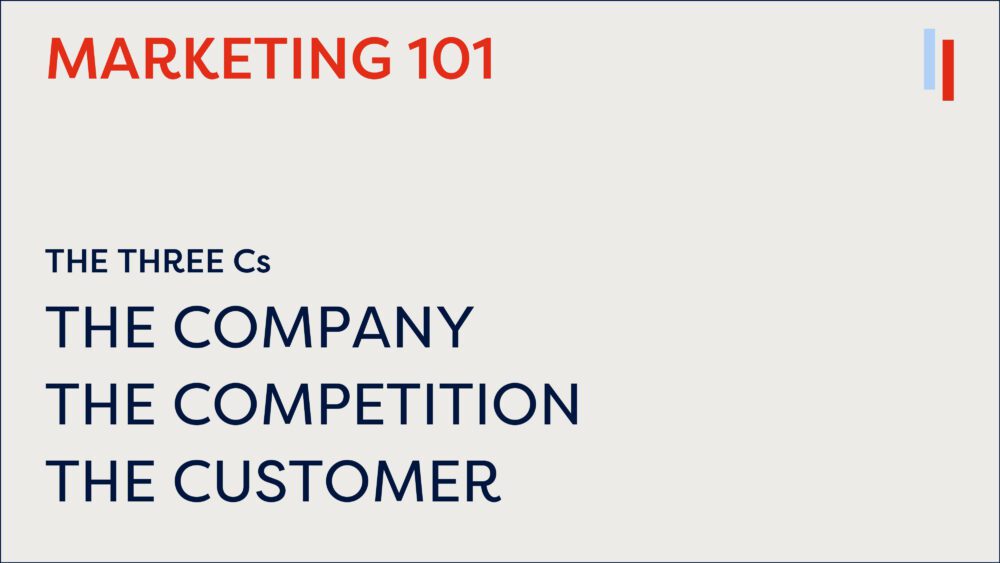
At its core, marketing sits at the intersection of three forces: what a company can build, what customers want, and the competitive landscape in which it operates.
Understanding the relationship between these three variables can save founders years of misdirected effort. Most founders treat marketing as a communications exercise or something to tackle just before launch. In reality, it is a core part of building a company and should be considered from the outset, in parallel with the product.
 (IP Graphic)
This is not just the product you are building, but the brand around it: the narrative, founder story, tone of voice, visual identity, and broader brand world.
Many founders focus entirely on product, but category-defining companies rarely rely on product alone. In fact, you don’t need a true unique selling point to differentiate. You need to create a brand world people want to be part of. Brands that create emotional connection are far more effective at changing behaviour and driving action (aka sales). As AI accelerates the production of content, audiences will inevitably become more numb to it, making genuine emotional connection even more important.
Liquid Death, for example, sells water, one of the most commoditised products imaginable, yet built a billion-dollar business through distinctive brand positioning and cultural storytelling. Customers were not simply buying water. They were buying into the identity – and a humorous one. This Liquid Death campaign does an incredible job of illustrating their brand world.
Founders can define competitors too narrowly. You are not just competing with companies that look like yours. You are competing with every existing way your customer currently solves the problem, including substitutes, habits, and workarounds.
Positioning helps customers quickly understand where your company fits within the landscape and how it should be evaluated. I often ask clients which brands their company would sit next to on a hypothetical store floor. The answer signals price point, offering, perceived quality, and the type of customer the brand is trying to attract. Any inconsistency between those signals usually points to a positioning issue.
For founders, it is also useful to think about competition less as a battle for market share and more as a source of insight. Competitors reveal the norms of a category and how they communicate across different marketing channels. What does a credible website look like in your industry? What price ranges feel normal? What signals legitimacy?
Studied carefully, these patterns offer a blueprint for both what to follow and where an opportunity might exist to do something different. Slack captured this dynamic well in one of its early adverts, which openly compares itself with competing workplace tools while explaining why teams might choose Slack instead.
 (Slack image link)
This is often the most difficult variable in marketing, and the one founders most frequently misjudge.
There is a common assumption that if you build a good product, customers will recognise its value. The reality is that “if you build it, they will come (and buy)” is rarely how markets work.
Understanding the customer requires more than simply identifying who they are. It requires understanding how they think, what motivates them, and what signals trust. This includes defining the muse the brand is built around, the target customer demographics, and the broader marketing audience (which is wider than the actual customer base). It also involves understanding customer behaviours, such as how they shop, what influences their purchasing decisions, and what they expect from brands in your space.
Airbnb’s 2014 “Belong Anywhere” campaign illustrates this well. Rather than positioning itself as an alternative to hotels, Airbnb addressed the emotional barrier of staying in a stranger’s home. By reframing the experience around belonging, the brand built trust and created a more meaningful connection with its audience.
Finally, founders often overlook that investors are also a type of customer. They evaluate a company through similar lenses of narrative, credibility, and perceived opportunity.
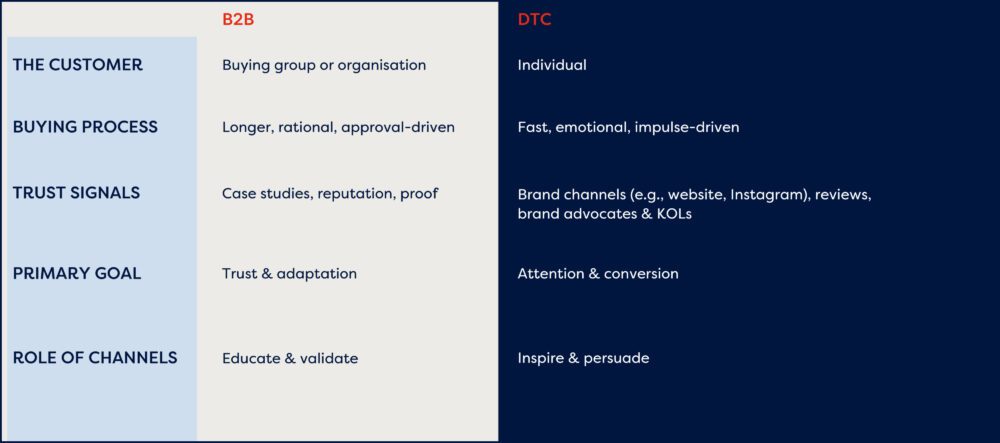
It’s important to recognise that you can’t apply the same marketing playbook across different business models. B2B and DTC companies operate under fundamentally different dynamics, from how decisions are made to what signals trust.
 (IP Graphic)
In B2B, decisions are typically made by buying groups and organisations. The process is longer, more rational, and driven by risk reduction, which is why credibility signals such as case studies, reputation, and proof of results matter so much.
In DTC, the customer is an individual. Decisions are faster and more emotionally driven, which means attention, brand perception, and social proof play a much larger role.
Despite these differences, one principle remains consistent: people are far more likely to engage with and remember brands that create compelling content.
Trust is what converts interest into purchase. Customers buy when the perceived value of a product outweighs the perceived risk of choosing it.
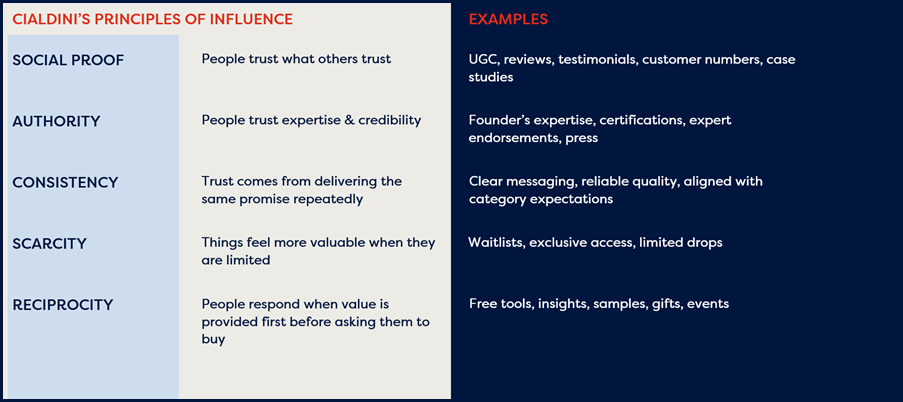
Strong brands build trust through a series of signals, which were famously outlined by behavioural psychologist Robert Cialdini in his 1984 book Influence: The Psychology of Persuasion, and they remain some of the most widely referenced concepts in marketing and behavioural science today.
 (IP Graphic)
While these principles are not new, what has changed is the speed and scale at which customers encounter them. The strongest brands rarely rely on just one element, instead layering multiple signals over time to reinforce credibility and build trust.
Brand Identity: Defining what your brand stands for
Once a company understands its customer, competition, and positioning, the next step is translating that strategy into a brand.
Strong brands are clear about what they stand for and how they communicate it. This begins with the foundations of brand identity: defining the company’s purpose, vision, mission, and values, alongside the narrative and founder story that explain why the business exists. Together, these elements shape the tone of voice and narrative of the brand.
In practice, most customers do not see these internal frameworks directly. They experience the outcome through the signals a brand creates. A useful way to think about this is to consider what immediately comes to mind when you think of the National Football League.
 (NFL link)
The NFL technically represents 32 franchises with a combined value of $25 billion, but it has become far more than a sports league. It is a cultural brand ecosystem. People instantly recognise the logo, the broadcast theme music, and the rituals surrounding game day and the Super Bowl. That cultural and commercial power is reflected in the value of its media rights, which generate more than $10 billion per year.
This is the power of brand identity: when done well, the brand becomes bigger than the product itself.
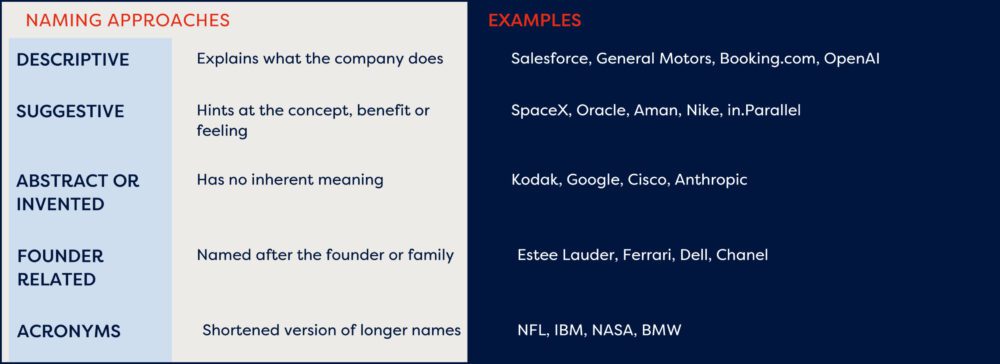
A company’s name is often the first signal customers encounter, making it a critical early decision for founders. Some names clearly describe what the company does, while others suggest a feeling or concept, draw on the founder’s identity, or are entirely invented. Each approach has advantages and trade-offs, but ultimately the name gains meaning through the brand that it’s built around.
Founders often ask whether their name is right for their brand or whether it can be changed later. In reality, a name is only one signal. It can influence positioning and perception, but its meaning is shaped over time through brand building. A weak name rarely kills a good company, although it can create friction. What matters most is avoiding obvious downside risks, such as search discoverability issues, confusion with existing brands, or intellectual property conflicts.
 (IP Graphic)
Humans process visuals far faster than language. A strong visual identity allows people to recognise a brand instantly. Just as important is the feeling that visual identity creates, because emotion is often what people remember.
Colour also shapes perception. Blue is often associated with trust, red with energy, black with luxury, and green with health or sustainability.
Brand equity is built gradually. Every campaign image, press placement, social post, and piece of packaging contributes to the visual system people associate with the brand. When those signals are consistent, recognition strengthens. When they are not, the brand becomes harder for people to understand or remember.
For instance, many people would likely be able to identify which brand this image belongs to. Ralph Lauren demonstrates how visual identity compounds over time. Decades of consistent imagery, styling, and storytelling have created a recognisable brand world that extends far beyond clothing.
 (Ralph Lauren Spring 2025 Campaign link)
Once a brand’s identity is defined, the next question is how it reaches people. Marketing channels are where a brand communicates with its audience and builds demand.
These channels can be digital or physical, organic or paid. The right mix depends on where your customers already spend time and how they prefer to discover and evaluate new products. Different channels also require different styles of communication. Remember the “Dolly Parton Challenge” meme that showed how the same person might present themselves differently across LinkedIn, Facebook, Instagram and Tinder? Each platform has its own tone and expectations, but the underlying identity remains the same.
 (Dolly Parton’s Instagram link)
Founders often ask which channels to prioritise. Early on, the focus should be validating the product and learning from early customers through simple channels such as a website, social media, founder networks, and direct outreach. The goal is to learn who the customer is and why they buy.
As the business grows, the focus shifts to building awareness and credibility through content, email and community building, partnerships, and selective paid social. At scale, growth is accelerated through performance marketing, paid influencers and endorsements, and larger brand activations.
There is no single correct channel strategy. The choices founders make will depend on the resources available to them, including time, budget, and team.
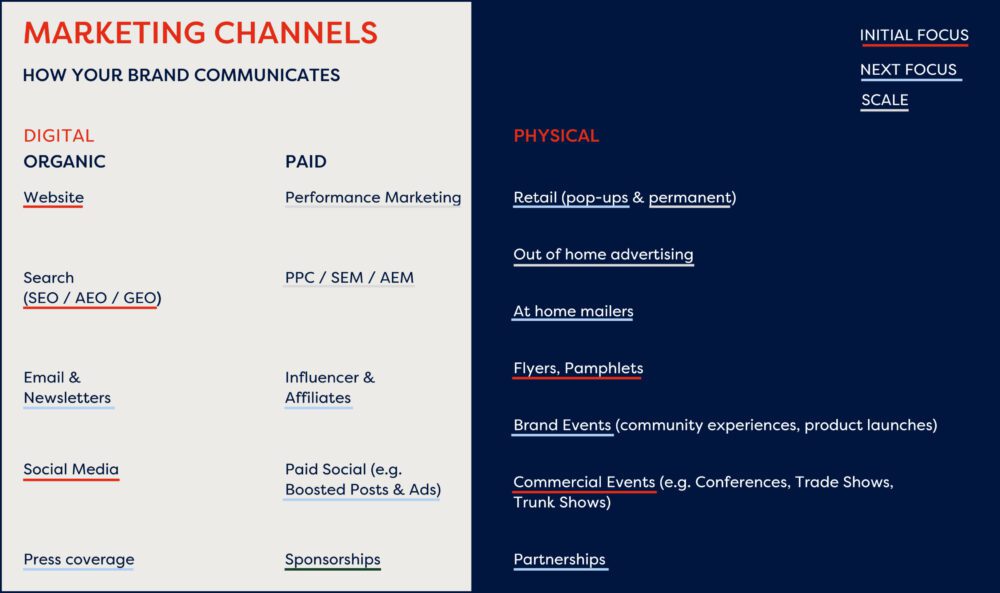 (IP Graphic)
The hardest part of marketing is building momentum. Turning on one or two channels rarely leads to immediate growth. Marketing works through accumulation, as repeated touchpoints build familiarity and trust. Over time these signals reinforce each other and a snowball effect begins to form. What feels like a customer’s first encounter with a brand is often the result of many earlier exposures, and the journey from awareness to purchase can take days, months, or even years depending on the product and perceived value.
Experiential marketing plays an important role in this process. While digital channels are often the first tools founders reach for, real-world interactions create stronger and more immediate connections with customers. Events allow people to experience a brand directly, building awareness, community, and word-of-mouth. With AI impacting digital experiences, physical ones will become even more valuable, as real-world interactions become more distinctive and memorable.
